Passprint

ICAO Doc 9303 standards

ICAO-compliant passport photos — framing baselines explained

ICAO Doc 9303 Part 3 defines measurable rules for faces in machine-readable travel documents — head size as a percentage of frame height, maximum rotation, background uniformity, and image quality. National authorities overlay their own millimetre sizes on top of that baseline. Passprint automates the measurable ICAO criteria, then layers country presets.

ICAO auto-framingTilt correctionCompliance score
Passprint ICAO compliant passport photo workflow: upload portrait, AI background removal, compliant sizing, and print-ready A4 sheet
International standards

ICAO rules are detailed — your software should know them not your counter staff at 5 PM on a Saturday

Face height percentage (typically 70–80% of image height), head rotation limits (±5°), and background uniformity each affect whether a photo passes automated border checks. Passprint encodes ICAO guidance into every processing run, then applies India, UK, US, Canada, or Schengen outer sizes on top. Passprint automates the entire workflow from upload to print-ready sheet in just a few clicks.

Studio challenge

Automated ICAO framing

Face detection positions the head within the percentage band ICAO Doc 9303 describes for machine-readable documents.

01 / 03
Studio challenge

Compliance scoring before export

See a score highlighting tilt, crop, or contrast issues while you can still adjust — not after the client has left.

02 / 03
Studio challenge

Works across country presets

ICAO framing pairs with India, UK, US, Canada, and Schengen size presets so international studios use one platform.

03 / 03
ICAO Doc 9303 framing

International baseline vs country overlays

ICAO sets the biometric face-image baseline used worldwide for machine-readable travel documents. Countries then add outer print sizes (35×45 mm, 2×2 in, 50×70 mm) and sometimes millimetre head-height bands. Use this page for the global baseline — open country guides for national overlays.

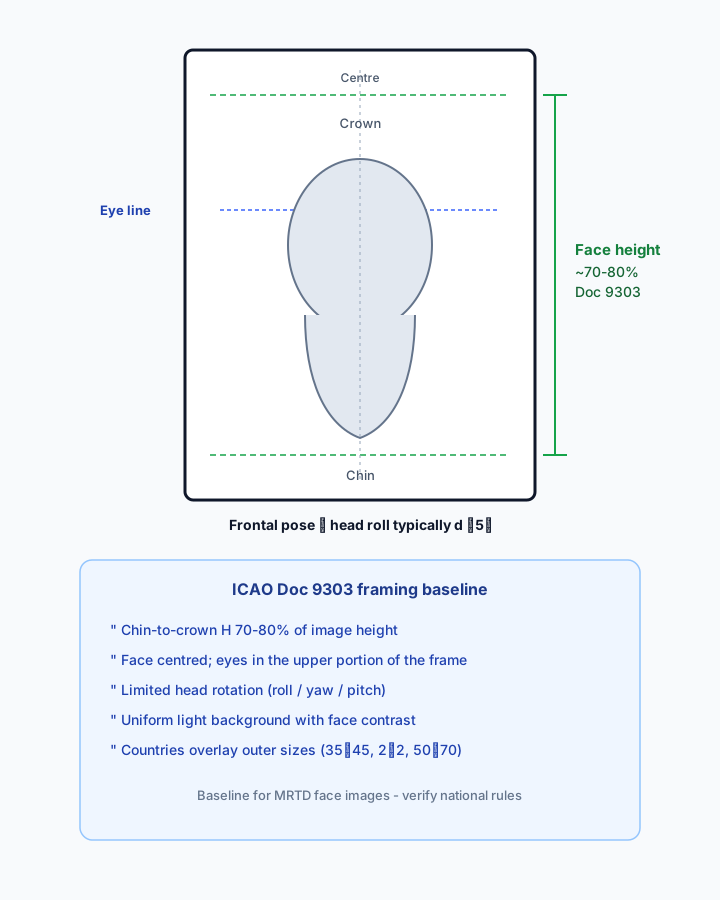
Annotated ICAO Doc 9303 passport photo framing diagram showing chin-to-crown face height at about 70 to 80 percent of image height, centred head, and eye-line placement
ICAO-style face-height band (~70–80% of image height) with centred head — the baseline countries overlay with their own outer sizes.

ICAO baseline vs country overlays

SpecICAO Doc 9303 baselineTypical country overlayExample destinations
Outer print sizeNot fixed to one mm sizeNational mm or inch size35×45 · 2×2 · 50×70
Face / head height~70–80% of image heightMay add mm or inch bandsUK 29–34 mm · US 1–1⅜ in · CA 31–36 mm
Head rotationLimited roll / yaw / pitchUsually follows ICAOMost passport & visa forms
BackgroundUniform light, good contrastOften white / off-white / cream-greyIN/US/CA white · UK cream/grey/white
ResolutionAdequate quality; ~300 DPI printsNational pixel guidanceStudio 300 DPI exports
AcceptanceInternational biometric baselineIssuing authority decidesAlways verify official pages

Doc 9303 face height, tilt, and country layering

Doc 9303 face height

The distance from the bottom of the chin to the top of the head (including hair) should occupy roughly 70–80% of the total image height. Eyes sit in the upper portion of the frame. This percentage band is the core ICAO framing rule Passprint targets before country millimetre overlays.


Centring and eye line

The full face should be centred, looking directly at the camera, with both eyes open and visible. Extreme close-ups that crop ears or crown, or wide shots with a tiny face, fall outside Doc 9303 expectations.

Rotation limits

Head roll is typically limited to about ±5°, with similarly tight limits on pitch and yaw. Tilted selfies fail automated checks even when size millimetres look correct. Passprint’s tilt correction helps bring portraits back toward frontal.

Background uniformity

ICAO expects a uniform light background with adequate contrast to the face — not patterned walls or outdoor scenes. National rules then name white, off-white, or cream/grey. See the white background guide for replacement tips.

Country overlays on ICAO

India and Schengen use 35×45 mm rectangles; the US uses 2×2 inch squares with inch head height; Canada uses 50×70 mm with a 31–36 mm face-height band; the UK keeps 35×45 mm with a 29–34 mm chin-to-crown rule. ICAO is the shared baseline — not a substitute for those overlays.

ISO/IEC 19794-5

Related face-image data standards (ISO/IEC 19794-5) align with ICAO biometric photo expectations for interoperable systems. Studios rarely need the ISO text day-to-day, but it explains why face-height percentages and frontal pose matter beyond local print shops.

Compliance scoring

Passprint surfaces tilt, crop, and contrast factors before export so operators can fix issues while the client is still at the counter. A high score does not guarantee government acceptance — it flags measurable ICAO-aligned risks.

Print resolution

Printed travel-document photos are commonly produced at 300 DPI with adequate pixel dimensions for the chosen outer size (for example ~413×531 px for 35×45 mm). Soft phone crops fail when enlarged to print size.

No guarantee of acceptance

Passprint applies ICAO-aligned framing and country presets. Final acceptance depends on each country’s latest rules, the source portrait quality, and human or automated review at the issuing authority.

Apply ICAO framing in the maker

Open the passport photo maker to run face detection, tilt correction, and a country size preset on top of ICAO baselines.

Open passport photo maker

ICAO workflow

How Passprint applies ICAO standards

Upload, run ICAO auto-framing with compliance scoring, apply a country preset, and export — measurable criteria applied before you print.

1

Upload portrait

Well-lit, forward-facing photos produce the best compliance scores.

Person taking a selfie to upload as passport photo
Upload Photo
2

ICAO auto-framing

Face detection centres the head and applies Doc 9303 percentage bands.

Portrait being AI-processed
Processing
3

Review compliance score

Tilt, crop, and contrast factors are highlighted for operator review.

Processed passport photo with compliant background
Original selfie before processing
25 mm
35 mm ISO
35 mm
25 to 35 mm (50 to 69%)
4

Export with country preset

Layer India, UK, US, Canada, or Schengen sizing on top of ICAO baselines.

For Print (A4).pdf300 DPI

Passport Size Photos

A4 · 210 × 297 mm · 35 × 45 mm

ICAO automation

ICAO compliance tools. Measurable, not guessed.

Automated framing, tilt correction, and scoring based on ICAO Doc 9303 measurable criteria.

ICAODoc 9303
ScorePre-export
TiltCorrection
01
ICAO

Automated ICAO framing

Face detection positions the head within the percentage band ICAO describes for MRTDs.

02
Quality

Compliance scoring

See tilt, crop, and contrast factors before the client leaves your studio.

03
Presets

Layers with country presets

ICAO baselines plus India, UK, US, and Schengen sizing on one platform.

04
Background

Background uniformity

Plain tones that meet ICAO contrast expectations for automated checks.

05
Layout

Print layout after scoring

Fix issues flagged by the score, then export multi-copy A4 sheets.

06
Studio

Audit-friendly preview

Review framing adjustments before spending a credit on the final export.

ICAO FAQ

ICAO passport photo standards explained

ICAO Doc 9303 Part 3 (Volume 1) defines the international baseline for passport and visa photographs used in machine-readable travel documents. National authorities may add stricter outer-size or millimetre head-height rules.

Passprint uses AI-assisted processing for background replacement, face framing, and sizing. Final acceptance is decided by the issuing authority — always verify against the official references on this page and inspect your printed sheet before submission.

Last reviewed: July 31, 2026

Apply ICAO framing automatically. See compliance scores.

Tilt correction, face-height rules, and scoring before you export.